How to Warm Up When You Are Already Sore
Quick Answer: Ordinary muscle soreness improves with gentle movement and blood flow, and gets worse with aggressive static stretching or jumping straight into intensity. Warm up longer, start lighter, and use the first ten minutes as a test rather than a formality. If it eases as you move, train. If it sharpens, that is different information and worth respecting.
A warm-up on a fresh body is a formality.
On a sore body it is a diagnostic, and it is the most useful ten minutes of the session.

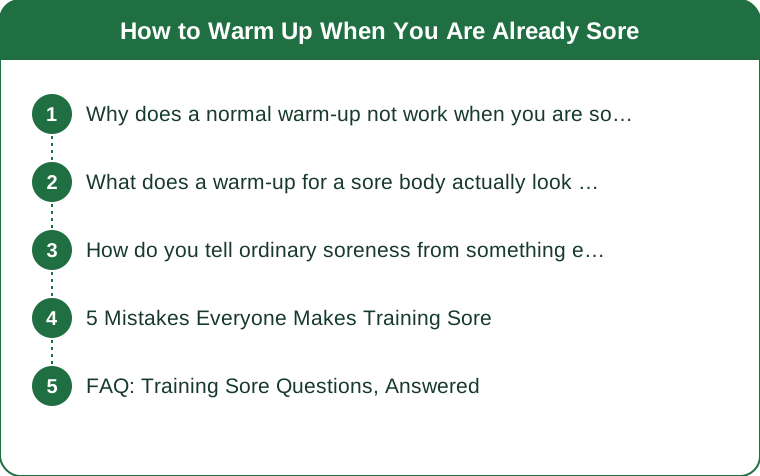
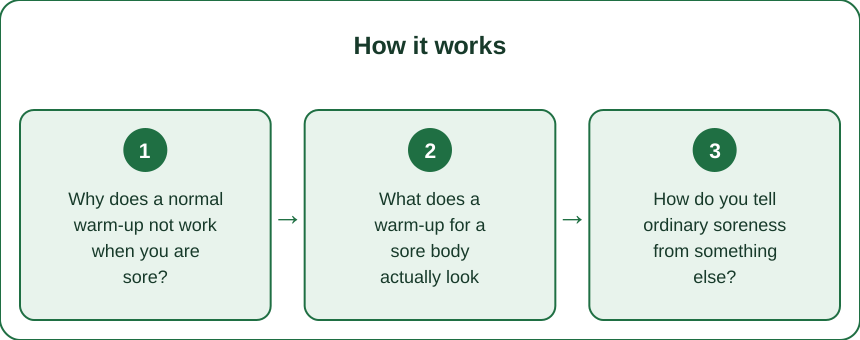
Why does a normal warm-up not work when you are sore?
Because it was designed for a different starting condition.
Sore muscles are less efficient and produce force differently. Ordinary delayed soreness comes with reduced strength and altered movement patterns for a day or two. Your normal warm-up loads assume normal capacity, and that assumption is temporarily wrong.
The usual warm-up is too short. A fresh body reaches working temperature in five to ten minutes; a sore one needs longer to move comfortably. Doubling the warm-up length is the single most effective adjustment.
Soreness changes how you move without you noticing. You compensate around the sore area, loading other tissue in unfamiliar ways. The compensation is where secondary problems start, which is why the second session after a hard one is often when something tweaks.
Aggressive static stretching of a sore muscle is the classic error. It provides brief relief and does nothing for the underlying process, and forcing range into tissue that is already irritated is not helpful. Movement beats stretching here, clearly.
Starting at full intensity is the other error. Sore muscles usually ease considerably after ten minutes of easy work - but only if you give them the ten minutes. The first set tells you very little; the fourth tells you a lot.
And the psychology gets in the way. Feeling sore makes people either abandon the session entirely or attack it to prove a point. Neither is the useful response, and the middle option is available.
What does a warm-up for a sore body actually look like?
Longer, gentler, and structured as a test with a decision point.
Start with five to ten minutes of easy general movement. Walking, easy cycling, or an easy row - enough to raise temperature without loading anything specifically. Longer than you would normally bother with, and this part is non-negotiable.
Move the sore area through range without load. Gentle, controlled, full-range movement encourages blood flow to the area, which is what actually helps ordinary soreness. Slow and unloaded, not stretched and held.
Add dynamic work that resembles the session ahead. If you are squatting, do unloaded squats. If you are running, do easy strides. Specificity matters more when you are sore, because it is how you find out what the session will feel like.
Then take a proper decision point. After ten to fifteen minutes, ask honestly whether it has eased, stayed the same, or worsened. Eased means train. Same means train lighter. Worse means change the plan.
Build up through more warm-up sets than usual. Where you might normally do two, do four, with smaller jumps between them. The extra sets are diagnostic, not wasted volume.
And plan the session around the sore area rather than through it. Train something else hard and give the sore area easy volume. A hard session is still available - just not for that muscle today.

How do you tell ordinary soreness from something else?
Five distinctions that are worth knowing well.
Ordinary soreness is diffuse; injury tends to be specific. A general ache across a whole muscle group behaves differently from a sharp point you can put a finger on. If you can point to it precisely, treat it with more caution.
Soreness eases with warm-up; injury often does not. This is the most practical single test available, and it is the reason to structure the warm-up as a diagnostic. Improvement over ten minutes is reassuring.
Soreness peaks a day or two after and then improves. Something that is getting worse on day three, or that appeared suddenly during a session, follows a different pattern. Trajectory matters as much as intensity.
Joint pain is not muscle soreness. Aching in the muscle belly is common after hard work; pain in a joint is not the same thing and should not be trained through. The distinction is worth learning and most people can feel it clearly once they look for it.
Sharp, catching, or shooting sensations are stop signals. So are swelling, significant loss of strength, and anything that changes how you walk. Those warrant assessment rather than a modified warm-up. This is general information, not medical advice.
And soreness that never fully resolves between sessions is a volume signal. Persistent, accumulating soreness week after week usually means the overall load is too high. The fix is a lighter week, not a longer warm-up.
5 Mistakes Everyone Makes Training Sore
Static stretching the sore muscle hard. It feels productive, delivers a few minutes of relief, and does not address the process. Gentle movement through range does considerably more.
Skipping the warm-up because you are already going to be uncomfortable. This is backwards - the sorer you are, the more the warm-up is doing. The days you least want to warm up are the days it matters most.
Judging the session on the first set. Sore muscles often feel dramatically better by the fourth set, and abandoning after the first discards a session that would have been fine. Give it fifteen minutes before deciding.
Training the sore area hard to work it out. Adding heavy load to already-fatigued tissue increases the recovery cost rather than shortening it. Easy volume helps; hard volume does not.
Taking painkillers to get through it. Masking the signal removes the information the warm-up was supposed to give you, which is the one thing you actually need. Reduced sensation is not reduced load.
And the bonus mistake: treating soreness as a measure of a good session. It tracks novelty and eccentric load more than effectiveness. The best sessions often produce very little of it, which is worth remembering when a session leaves you fine.
FAQ: Training Sore Questions, Answered
Should I train at all when I am sore?
Usually yes for ordinary soreness, with reduced intensity and a longer warm-up. Gentle movement typically improves it faster than complete rest does.
How much longer should the warm-up be?
Roughly double what you would normally do, with more gradual warm-up sets. Fifteen minutes instead of seven is a reasonable rule.
Does soreness mean the last session was too hard?
Not necessarily - novelty and eccentric-heavy work produce soreness at any sensible volume. Soreness that lingers past three days or accumulates week to week is the version worth acting on.
TL;DR:
- Sore bodies need roughly double the warm-up, and the warm-up doubles as a diagnostic.
- Gentle unloaded movement beats aggressive static stretching for ordinary muscle soreness.
- Take a decision point at ten to fifteen minutes: eased means train, worse means change the plan.
- Diffuse ache that improves with movement is ordinary; sharp, specific, or joint pain is not.
- Train something else hard rather than pushing the sore area - a hard session is still available.
Next sore day, give yourself fifteen minutes of easy work before you decide anything about the session. Most of the time the decision makes itself.
Keep Reading
This article is for general informational and styling purposes only. Fit, sizing, and product availability may vary.