Why a Lower Body Warmup Does Nothing for Your Overhead Press
Quick Answer: General cardio raises core temperature but does very little for tissue that is not being used. A shoulder needs its own preparation: rotator cuff activation, thoracic extension, and a progressive load ramp through the actual movement pattern. Ten minutes on a bike prepares your legs, and your legs are not what is going overhead.
You do your ten minutes, you feel warm, you load the bar.
And the first overhead set feels stiff, restricted at the top, and vaguely unstable in a way the third set does not.
Your warmup worked. It just warmed up something else.

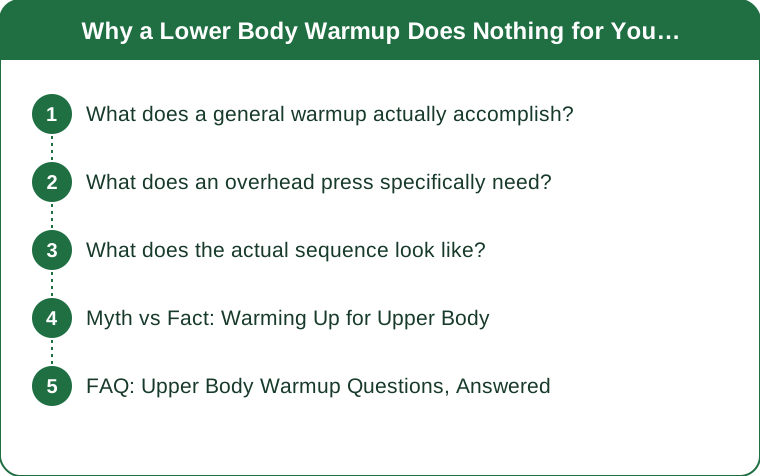
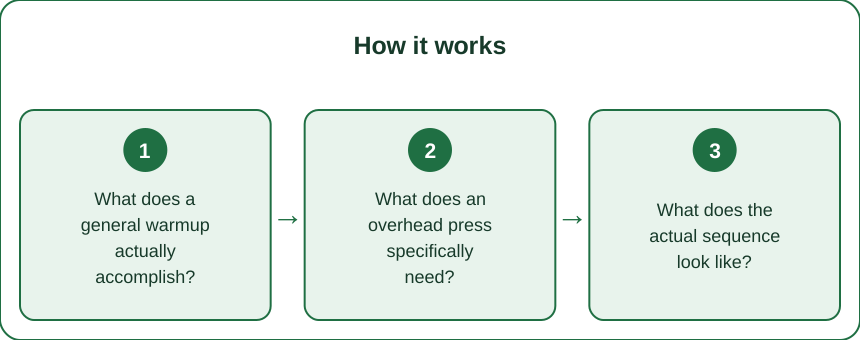
What does a general warmup actually accomplish?
Real things, but a narrower list than most people assume.
It raises core temperature, which improves enzyme function, nerve conduction speed and muscle compliance systemically. That is genuine and worth doing.
It raises heart rate and redistributes blood flow toward working muscle, which shortens the lag at the start of a session.
It increases general arousal, which matters for coordination and force production.
What it does not do: prepare a specific joint’s range of motion, activate the small stabilizers around that joint, or rehearse the motor pattern you are about to load.
Those are local effects and they require local work. The synovial fluid in your shoulder responds to the shoulder moving, not to your legs moving. The rotator cuff wakes up when it is asked to do something, not when your heart rate rises.
The overhead press is the clearest example of the gap, because it demands more from more places than almost any other lift: shoulder external rotation, thoracic extension, scapular upward rotation, and enough core stability to stop the whole thing turning into a standing back arch.
What does an overhead press specifically need?
Four things, and skipping any one of them shows up in the first set.
Thoracic extension. To press straight overhead you need your upper back to extend. If your thoracic spine is stuck in flexion — which it is, after a day at a desk — you cannot get the bar over your head without arching your lumbar spine instead. This is the single most common reason an overhead press feels restricted at the top, and it has nothing to do with the shoulder itself.
Scapular upward rotation. Your shoulder blade has to rotate upward as your arm goes overhead. If it does not, the humerus runs out of room and you get impingement-type discomfort. The serratus and lower trapezius do this job and both go quiet from sitting.
Rotator cuff activation. The cuff centers the humeral head in the socket during pressing. Cold, unactivated cuff means a slightly less stable joint under load, which is the vague instability people describe on set one.
Movement rehearsal at increasing load. The motor pattern needs practice at low load before it gets heavy load. This is the part everyone does — the empty bar sets — and it is doing more than warming muscle; it is calibrating the pattern.

What does the actual sequence look like?
Five to seven minutes, and it goes after your general warmup, not instead of it.
1. Thoracic extension, 60 seconds. Foam roller under the upper back, extend over it for a few slow reps. Or a wall slide or an open-book rotation. The goal is to get the upper back moving before you ask it to hold an extended position under load.
2. Band pull-aparts, 2 sets of 15. Wakes up the rear delts and the mid-back, and directly counters the desk posture you arrived with. Slow, with a pause at the end range.
3. External rotations, 2 sets of 12 per side. Light band or a very light dumbbell. This is the rotator cuff work, and light means light — this is activation, not training.
4. Wall slides or scapular push-ups, 10 reps. Trains upward rotation directly. Wall slides are the higher-value option for pressing specifically.
5. Ramp the actual lift. Empty bar for 10 reps, then roughly 40 percent for 5, 60 percent for 3, 80 percent for 1 or 2 before your working weight. The ramp is not optional and it is where a surprising amount of the preparation actually happens.
One thing to leave out: long static stretching of the shoulder before pressing. Holding a stretch for 60 seconds or more can temporarily reduce force output and stability, which is the opposite of useful before an overhead lift. Save the long holds for after.
Myth vs Fact: Warming Up for Upper Body
Myth: If you are sweating, you are warmed up. Fact: Sweating means your core temperature rose. It says nothing about whether the specific joint you are about to load has been prepared.
Myth: The warmup sets are the warmup. Fact: Ramp sets are essential and they are not sufficient for the overhead press, because they do not address thoracic mobility or cuff activation. A shoulder that cannot get overhead well at the empty bar will not get better at 60 percent.
Myth: Rotator cuff work should be heavy to be useful. Fact: Before a session, it is activation, and heavy cuff work pre-fatigues exactly the muscles you need for stability. Light bands, high control.
Myth: Shoulder mobility is a stretching problem. Fact: For most desk-bound lifters it is a thoracic spine problem. Stretching a shoulder that is being restricted by a stiff upper back produces very little change.
Myth: You need a long warmup for everything. Fact: You need a specific warmup for the demanding thing you are about to do. A long general warmup before a bench press and a short specific one before an overhead press is exactly backwards.
FAQ: Upper Body Warmup Questions, Answered
How long should this actually take?
Five to seven minutes of specific work plus your ramp sets. If you are pressed for time, cut a set from the end of your session rather than cutting this.
Do I need this for bench press too?
A version of it, yes — cuff activation and pull-aparts transfer directly. Bench demands less thoracic extension and less overhead range, so it is more forgiving of a short warmup.
My shoulder clicks during warmup. Is that a problem?
Painless clicking is common and usually not concerning. Painful clicking, catching, or clicking that comes with weakness deserves an assessment. This is general information, not medical advice.
What if I train in the morning?
Add time. Thoracic mobility and shoulder range are both at their daily worst after a night lying down, and morning overhead work needs the longest preparation of any session in the week.
Should I warm up differently as it gets colder?
Yes — cooler ambient temperature slows the temperature rise, so the general portion needs a few extra minutes in fall and winter. The specific shoulder work stays the same.
TL;DR:
- General cardio raises core temperature and does essentially nothing for a joint it did not move.
- Overhead pressing needs four things: thoracic extension, scapular upward rotation, cuff activation, and a load ramp.
- A restricted top position is usually a stiff upper back, not a tight shoulder — stretching the shoulder will not fix it.
- Five to seven minutes: t-spine extension, pull-aparts, external rotations, wall slides, then ramp the bar.
Ten minutes on the bike is a fine warmup for your legs. Your legs are not the thing going over your head.
Keep Reading
This article is for general informational and styling purposes only. Fit, sizing, and product availability may vary.