What Actually Happens When You Skip Your Warmup for a Time Crunch
Quick Answer: Skipping a warmup doesn’t cause immediate injury every time, but it measurably reduces performance in your first several minutes (slower reaction time, less range of motion) and raises the risk of strain specifically during high-intensity or heavy-load movements attempted cold. A 5-minute abbreviated warmup captures most of the benefit when time is genuinely short.
With five minutes to spare before a workout, skipping the warmup entirely feels like a reasonable trade. The actual cost is more specific than ‘it’s risky’ — and understanding exactly what’s lost makes it easier to protect the parts that matter most.

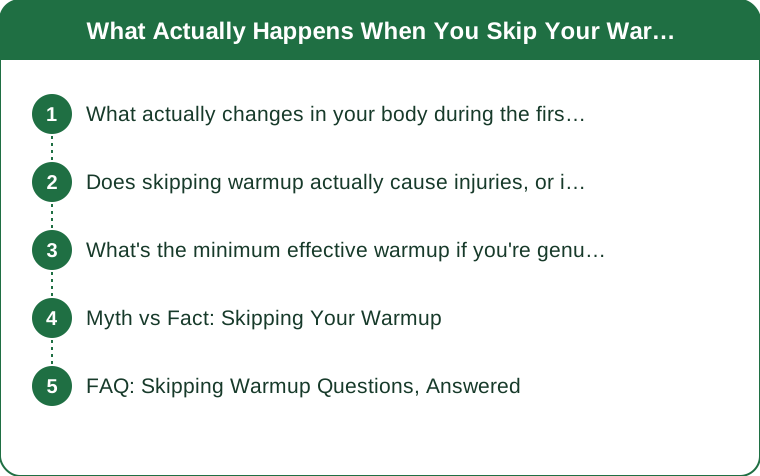
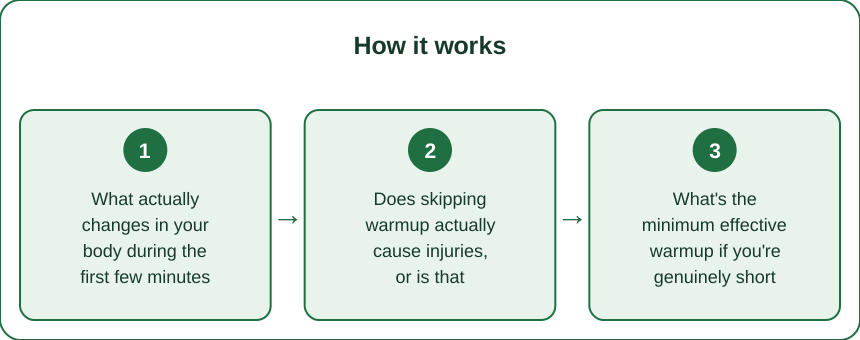
What actually changes in your body during the first few minutes of a warmup?
A proper warmup raises muscle temperature, which increases elasticity and reduces the risk of strain specifically in cold tissue asked to move through a large range quickly. It also primes the nervous system, improving reaction time and coordination — which is why the first few reps of a cold workout often feel clumsier than reps ten minutes in, warmup or not.
Does skipping warmup actually cause injuries, or is that overstated?
The research is more nuanced than ‘always causes injury’ — a single skipped warmup for a light or moderate session carries relatively low risk. The real danger is skipping warmup specifically before heavy lifting, sprinting, or explosive movements, where cold tissue asked for maximum output is a well-documented risk factor for strains.

What’s the minimum effective warmup if you’re genuinely short on time?
A 5-minute version focused on raising heart rate slightly (light cardio) and moving your specific workout’s key joints through their full range captures most of the benefit. For a lower-body strength session, that might mean bodyweight squats and leg swings; for an upper-body session, arm circles and light-resistance versions of your first exercise.
This abbreviated version isn’t as complete as a full 10-15 minute warmup, but it addresses the two biggest risk factors — cold tissue and unprimed coordination — in a fraction of the time.
Myth vs Fact: Skipping Your Warmup
Myth: Skipping warmup once in a while doesn’t matter at all. Fact: For light sessions, the risk is genuinely low — but for heavy or explosive training, even one skipped warmup before a max-effort lift measurably raises strain risk.
Myth: A warmup has to be 15-20 minutes to be worthwhile. Fact: A focused 5-minute version covering heart rate and range of motion for your specific workout captures most of the benefit when time is tight.
FAQ: Skipping Warmup Questions, Answered
Is it worse to skip warmup for cardio or for strength training?
Strength training, particularly heavy or explosive lifts, carries more risk when skipped — cold tissue under high load is the classic strain scenario. Cardio warmups matter more for performance than injury prevention.
Can stretching alone replace a proper warmup?
Static stretching alone doesn’t raise muscle temperature or heart rate the way dynamic movement does, so it’s a weaker substitute — dynamic movement is the more effective time-crunch option.
How much performance is actually lost by skipping warmup?
Studies generally show measurable drops in power output and reaction time for the first several minutes of a cold workout — often enough to affect your heaviest sets or fastest efforts specifically.
TL;DR:
- Skipping warmup mainly costs you performance and raises strain risk in cold tissue under load
- The risk is highest specifically before heavy, explosive, or max-effort movements
- A 5-minute abbreviated warmup (light cardio plus range of motion) covers most of the benefit
- Static stretching alone doesn’t substitute for the heart-rate and temperature effects of a real warmup
When time is genuinely tight, a shortened warmup beats none — but skipping it entirely before your heaviest efforts is the specific moment it costs you most.
Keep Reading
This article is for general informational and styling purposes only. Fit, sizing, and product availability may vary.