The Warmup Order Mistake: Why Mobility Work Before Activation Undoes Both
Quick Answer: Doing deep static mobility stretching before activation drills (glute bridges, band walks, light plyometrics) can temporarily reduce the muscle’s ability to fire powerfully right afterward, so the more effective warmup order is light general movement first, then activation drills, then any deeper mobility work saved for the very end or a separate session.
Many warmup routines list mobility and activation as interchangeable steps, when the sequence between them actually changes how effective the whole warmup is.

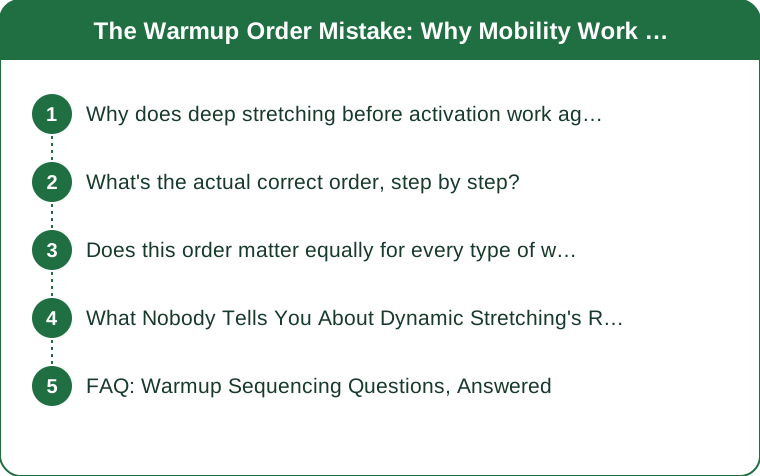
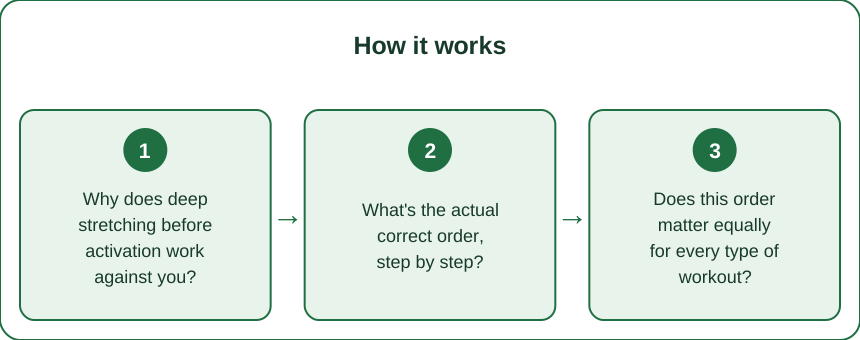
Why does deep stretching before activation work against you?
Because prolonged static stretching temporarily reduces a muscle’s capacity for forceful, quick contraction, a well-documented short-term effect. Doing this right before activation drills that need exactly that forceful contraction (glute activation before squats, for example) works against the very thing activation work is trying to prime.
What’s the actual correct order, step by step?
Light general movement (a short walk, easy cycling) to raise body temperature, followed by activation drills targeting the muscles you’ll train, followed by dynamic (moving) stretches specific to the workout, with any deep static stretching saved for after the session entirely. This order primes muscles for power output rather than temporarily dampening it right before you need it.

Does this order matter equally for every type of workout?
Not quite equally — it matters most for strength training and explosive or plyometric work, where forceful muscle contraction right out of the warmup is the goal. For a steady, moderate-pace cardio session, the order matters somewhat less, since the demand on explosive force production is lower.
What Nobody Tells You About Dynamic Stretching’s Role
Dynamic stretching (leg swings, walking lunges with a twist) doesn’t carry the same force-reduction effect as static stretching, which is why it fits well between activation and the workout itself rather than needing to be avoided — the distinction between dynamic and static stretching timing is the detail most warmup routines skip explaining.
FAQ: Warmup Sequencing Questions, Answered
Is it ever fine to do static stretching early in a warmup?
For a very light, brief stretch, the effect is minor, but for anything held more than 30 seconds per muscle group, moving it to the end of the session avoids the temporary strength reduction risk before training.
How long should the full corrected warmup sequence take?
Roughly 8-12 minutes for most strength or explosive training sessions, covering general movement, activation, and dynamic stretching in that order.
Does this order apply to warming up for a run the same way it does for lifting?
Yes, in principle — light movement, activation-style drills (leg swings, high knees), then dynamic stretching specific to running mechanics, saving static stretching for the cool-down.
TL;DR:
- Deep static stretching before activation drills temporarily reduces forceful muscle contraction ability
- The correct order is light general movement, then activation, then dynamic stretching
- This sequencing matters most for strength and explosive training, less for steady cardio
- Dynamic stretching doesn’t carry static stretching’s force-reduction effect, so it fits earlier in the sequence
Swap the order of your warmup, not the exercises themselves, and the same routine primes your muscles more effectively.
Keep Reading
This article is for general informational and styling purposes only. Fit, sizing, and product availability may vary.