Warming Up in Cold Weather: The Extra Steps Most People Skip
Quick Answer: Cold weather warmups need roughly 5-10 minutes longer than a standard warmup and should stay indoors or in shelter until your body temperature rises, since cold muscles and joints take measurably longer to reach a safe, elastic working temperature than in mild conditions.
The warmup that works fine at 65 degrees isn’t enough at 35 degrees. Cold tissue behaves differently, and rushing the process is where cold-weather injuries actually happen.

Why does cold weather change warmup needs so much?
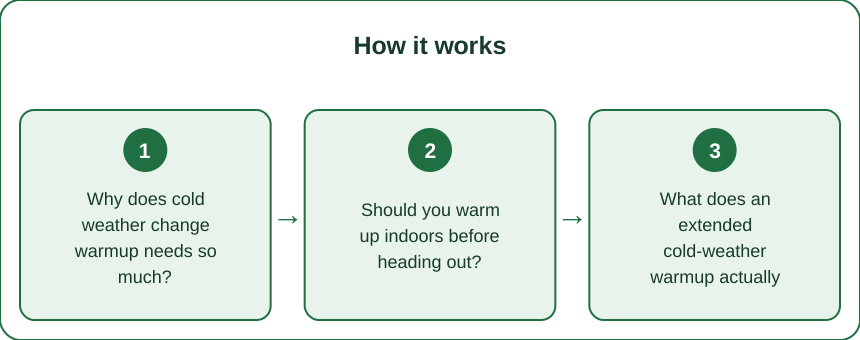
Cold reduces blood flow to your extremities and muscle tissue as your body prioritizes core temperature — muscles and connective tissue are measurably stiffer and less elastic in cold conditions, which means they need more time and more deliberate movement to reach a safe working range.
Should you warm up indoors before heading out?
Yes, whenever possible — starting your dynamic warmup indoors for the first 5 minutes gets your body temperature rising before you’re also fighting the cold air, which is more efficient than trying to warm up entirely outside in low temperatures.

What does an extended cold-weather warmup actually look like?
Add 5-10 minutes to your normal routine, with extra emphasis on larger muscle group movements first (leg swings, arm circles, bodyweight squats) before smaller joint mobility work — bigger movements generate more body heat faster than isolated stretches.
Static Vs Dynamic Stretching Before Cold Weather Exercise
Dynamic movement, not static stretching, should make up almost all of a cold-weather warmup. Static stretching on cold, stiff muscle tissue doesn’t improve elasticity the way it does on already-warm tissue, and can occasionally increase strain risk. Save static stretches for after your session when tissue is genuinely warm.
FAQ: Cold Weather Warmup Questions, Answered
How cold is cold enough to need this extra warmup time?
Most coaches use roughly 45°F (7°C) as the threshold where extended warmup becomes clearly worthwhile, with the need increasing further as temperatures drop.
Does clothing layering affect warmup needs?
Yes — inadequate layering during the warmup itself (before you’re generating heat from movement) can slow the whole process, so dress for the first 5 minutes of cold standing, not just the workout.
Is it riskier to skip warmup in cold weather than in mild weather?
Generally yes — cold, under-warmed tissue is associated with higher strain and pull risk in several studies, making warmup skip a bigger gamble in winter conditions than in mild weather.
TL;DR:
- Cold weather warmups need roughly 5-10 minutes longer than standard warmups
- Start indoors when possible to raise body temperature before facing cold air
- Prioritize big dynamic movements over isolated stretches to generate heat faster
- Save static stretching for after your session, when tissue is actually warm
Keep Reading
This article is for general informational and styling purposes only. Fit, sizing, and product availability may vary.