Do You Really Need to Warm Up Before Easy Cardio?
Quick Answer: For genuinely easy cardio — a walk, a gentle spin, an easy swim — a separate warm-up is largely unnecessary, because the first few minutes of the activity at a reduced pace serve as the warm-up. What does need a real warm-up is anything with intensity changes, anything after prolonged sitting, anything in cold weather, and anything for a body that is older, injured, or returning from a break. The variable is not the activity. It is the gap between your current state and what the session demands.
Warm up for the hardest thing you are going to do, not the average thing.

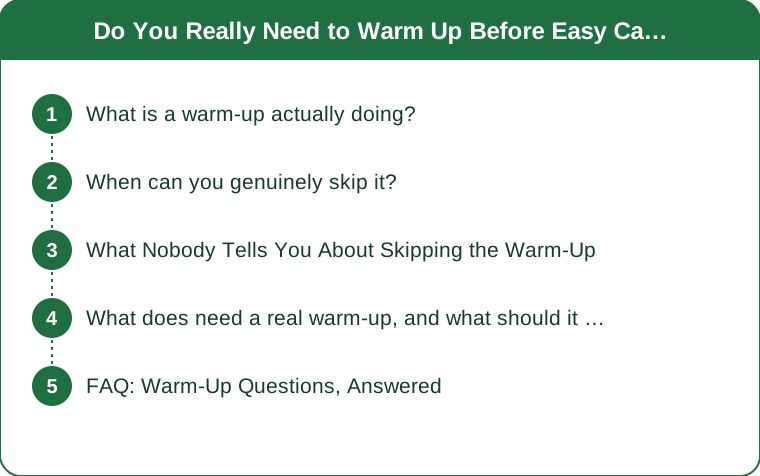
What is a warm-up actually doing?
Raising tissue temperature and preparing the nervous system. That is most of it.
The primary physiological effect is temperature. Warmer muscle contracts and relaxes faster, is more compliant, and works more efficiently. Most of the meaningful change happens in the first five to ten minutes of light activity, and it is largely why the term is literal.
Blood flow redistributes. At rest, a relatively small share of cardiac output goes to skeletal muscle. Light activity shifts a much larger share there, and that redistribution takes a few minutes.
Oxygen delivery kinetics improve. The lag between demand and delivery at the start of exercise is what makes the first minutes of any session feel disproportionately hard. Warming up moves that lag before the part that matters.
The nervous system gets rehearsal. Movement patterns run more smoothly after a few repetitions, which is why a warm-up for a skilled or explosive task is more valuable than one for a simple task.
Injury prevention evidence is more nuanced than the slogans suggest. Structured programmes that include strength and neuromuscular components have good evidence for reducing injury in field sports. A generic five-minute jog before a walk has essentially no evidence behind it, largely because nobody gets injured walking.
Which points at the real principle: a warm-up bridges the gap between your current state and the demands of the session. Small gap, small warm-up.
When can you genuinely skip it?
When the activity’s own first minutes can do the job.
Walking. Starting a walk at an easy pace for the first five minutes is the warm-up. No separate routine is required for a healthy person going for a walk, and treating it as though one is required is a reliable way to walk less.
Easy steady cardio at a constant low intensity. An easy spin on a bike, a gentle swim, an easy elliptical session. Start at the bottom of the intensity range and let the first five to ten minutes build, and you have warmed up without a separate phase.
Low-intensity movement at a familiar time of day in a warm environment for someone with no relevant history. The gap between rest and the demand is small.
The mechanism is that these activities are self-limiting. You cannot accidentally sprint a walk. There is no moment where an unwarmed tissue meets a sudden high load, which is the situation warm-ups exist for.
But note what you are actually skipping: the separate phase, not the gradual start. Beginning a session at your target intensity is the mistake, regardless of activity — and it is much more common on machines with a preset programme than in outdoor activity where pace naturally builds.

What Nobody Tells You About Skipping the Warm-Up
The first ten minutes always feel worse than the rest. That is oxygen delivery kinetics, not you being unfit. In a warmed-up session that feeling happens during the warm-up; in an unwarmed session it happens during the session — which is a large part of why sessions feel bad from the start.
It is why so many people quit in the first fortnight. A beginner who starts every run at their goal pace experiences the worst ten minutes of physiology repeatedly. The fix is not more willpower, it is starting slower.
Sitting is the hidden variable. After hours of sitting, hip flexors are shortened, glutes are quiet, and the thoracic spine is stiff. The same easy run has a much larger state-to-demand gap at 6pm after a desk day than at 10am on a weekend.
Age changes the answer. Tissue takes longer to become compliant and recovers less quickly from surprise. The warm-up you did not need at 22 is genuinely useful at 45, and this is one of the more reliable ways training changes with age.
Morning needs more than evening. Core body temperature is at its daily low overnight and rises through the day, so the same session requires a longer warm-up at 6am than at 6pm — and spinal tissues are more hydrated first thing, which is a reason to avoid deep loaded flexion early.
Cold changes it too. Cool air means tissue takes longer to reach working temperature. As autumn arrives, the warm-up that was adequate in July is not adequate in October, and this transition catches people every year.
What does need a real warm-up, and what should it contain?
Anything with intensity, complexity, or a big gap between where you are and what you are about to do.
Always warm up properly for: intervals or any hard efforts, lifting, sprinting, court and field sports, anything explosive, and any session that starts hard rather than building.
Warm up more than you think for: cold weather, early mornings, sessions after a full day of sitting, the first session back after time off, and anything with a history of a niggle in the tissue involved.
A workable structure, five to ten minutes:
Start with easy general movement. Walking, easy cycling, easy rowing — enough to raise temperature and breathing rate. Three to five minutes.
Then dynamic mobility through the ranges you will use. Leg swings, hip circles, walking lunges, arm circles. Movement through range, not static holds.
Then activation for the muscles that are about to matter, especially after sitting — glute bridges, band walks, a few bodyweight squats.
Then a specific ramp-up. Do the actual movement, easier and lighter, building toward the working intensity. Warm-up sets before a lift, strides before a run, easy rally before a match. This part is the most important and the most often skipped.
Save static stretching for afterwards. Long static holds immediately before power or speed work can transiently reduce force output. Short dynamic movement before, longer static holds after.
And keep the seasonal adjustment in mind. As the mornings cool, add a few minutes and start indoors where possible. It is the cheapest injury-avoidance change on the calendar.
This is general guidance, not medical advice. Anyone returning from injury should follow the specific guidance of their healthcare professional.
FAQ: Warm-Up Questions, Answered
Do I need to warm up before a walk?
For a healthy person, no separate routine is needed. Start the first five minutes at an easy pace and that is your warm-up.
Why does the first ten minutes of every run feel awful?
Oxygen delivery lags behind demand at the start of exercise, so the early minutes always feel disproportionately hard. Warming up moves that unpleasant phase out of the session itself.
Should I stretch before cardio?
Dynamic movement through range, yes. Long static holds are better afterwards, since they can briefly reduce force output before power or speed work.
Does the warm-up need to be longer in autumn?
Yes, modestly. Cooler air means tissue takes longer to reach working temperature, so adding a few minutes as the season turns is sensible — particularly for early morning sessions.
TL;DR:
- A warm-up bridges the gap between your current state and the session’s demands, so small demands need very little.
- Walking and easy steady cardio warm up on their own if you start at the bottom of the intensity range.
- Intervals, lifting, sprints, cold weather, early mornings, and post-sitting sessions all need a real warm-up.
- Build it as easy movement, dynamic mobility, activation, then a specific ramp-up in the actual movement.
Start your next session two notches easier than your target for the first five minutes. That is the whole intervention.
Keep Reading
This article is for general informational and styling purposes only. Fit, sizing, and product availability may vary.