Why Your Warmup Needs to Be Longer at Higher Elevation
Quick Answer: At elevations above roughly 5,000 feet, reduced oxygen availability slows the rate at which muscles and the cardiovascular system reach working temperature, meaning a warmup that’s sufficient at sea level often needs an extra 5-10 minutes at altitude to achieve the same readiness.
You did your usual warmup, felt ready, and then your first hard effort hit like you skipped it entirely. At altitude, your usual warmup isn’t actually the same warmup anymore.

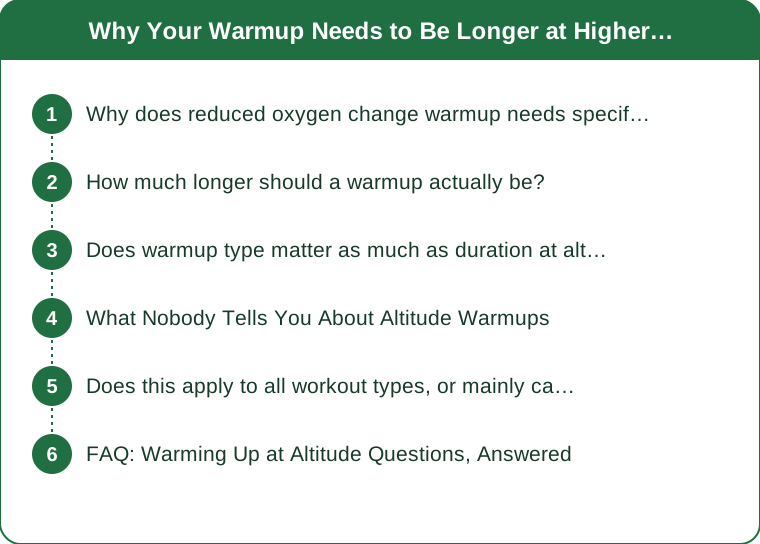
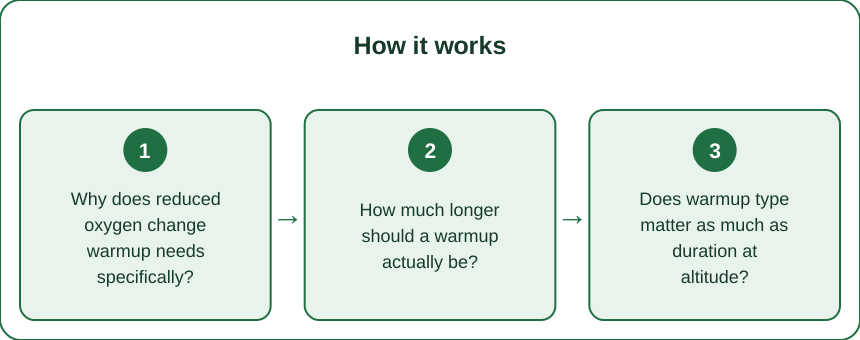
Why does reduced oxygen change warmup needs specifically?
A warmup’s core job is to gradually increase blood flow, muscle temperature, and cardiovascular readiness before higher-intensity effort. At altitude, lower oxygen availability means the same warmup intensity produces less actual physiological readiness per minute, since your body is working with a thinner oxygen supply to fuel that gradual ramp-up.
This is distinct from the pacing slowdown altitude causes during the main workout — it’s specifically about how long the preparation phase takes to actually prepare you, which is a separate and often overlooked altitude effect.
How much longer should a warmup actually be?
As a practical guideline, adding 5-10 minutes to a standard warmup above 5,000 feet, and leaning toward the higher end above 8,000 feet, gives your cardiovascular system more time to reach genuine working readiness. This isn’t about warming up harder — the same gradual intensity progression just needs a longer runway to arrive at the same physiological state.
Does warmup type matter as much as duration at altitude?
Somewhat — starting even more gradually than usual (a slower initial pace before building) matters more at altitude, since jumping into moderate intensity too quickly is more likely to produce early breathlessness that doesn’t fully resolve for the rest of the session. A warmup that ramps in very small, patient increments tends to work better than one with the same total duration but a steeper early ramp.

What Nobody Tells You About Altitude Warmups
Most altitude training advice focuses on race or workout pacing but rarely addresses that the warmup itself needs its own separate adjustment, treating warmup length as fixed regardless of elevation. This gap means many athletes correctly slow their main effort at altitude but still warm up on their sea-level schedule, undermining some of that pacing adjustment before the real work even starts.
It’s also rarely mentioned that arriving at altitude within the past 1-3 days makes this effect more pronounced than after a week or two of acclimatization — the warmup-length adjustment can be dialed back somewhat as your body adapts, rather than staying fixed for the whole trip.
Does this apply to all workout types, or mainly cardio?
It applies most noticeably to cardio and endurance-based training, where sustained oxygen delivery is the limiting factor. Strength training is less directly affected by the same mechanism, though a longer general warmup still helps at altitude simply because ambient effects (often colder, drier air at elevation) slow general muscle readiness regardless of the specific oxygen mechanism.
FAQ: Warming Up at Altitude Questions, Answered
Does this altitude warmup adjustment apply to indoor gyms at elevation too?
Yes — the oxygen effect is about elevation itself, not being outdoors specifically, so a gym in Denver has the same consideration as a trail in the same city.
Should I feel more out of breath than usual during an altitude warmup?
Some increased breathlessness during a longer warmup is expected and normal; it should ease as the warmup progresses, not intensify — worsening breathlessness is a signal to slow down further.
Does hydration affect how long a warmup needs to be at altitude?
Indirectly — altitude increases fluid loss through respiration, and mild dehydration can make the warmup feel harder and less effective regardless of duration, so hydrating well beforehand supports the whole process.
TL;DR:
- Reduced oxygen at altitude slows how fast a warmup produces real physiological readiness
- Add roughly 5-10 minutes to a standard warmup above 5,000 feet, more above 8,000
- Ramp intensity more gradually, not just longer, for better altitude warmup results
- Recent arrivals (1-3 days) need this adjustment more than acclimatized athletes
A warmup that works perfectly at sea level is running on borrowed time at elevation — a longer, more patient ramp-up is the fix, not more training intensity.
Keep Reading
This article is for general informational and styling purposes only. Fit, sizing, and product availability may vary.