The Warm-Up You Need After Sitting for Nine Hours Is Not the One You're Doing
Quick Answer: Nine hours of sitting shortens your hip flexors, switches off your glutes, and stiffens your thoracic spine - three specific problems a generic arm-circle warm-up never touches. An effective post-desk warm-up spends 8-10 minutes on hip extension, glute activation, and upper back rotation before anything else.
The 6pm workout is different from the 6am one, and not just because you’re tired. Your body has been in one position for nine hours and it has adapted to that position. Warming up as if you just rolled out of bed leaves the exact tissues that need attention untouched.

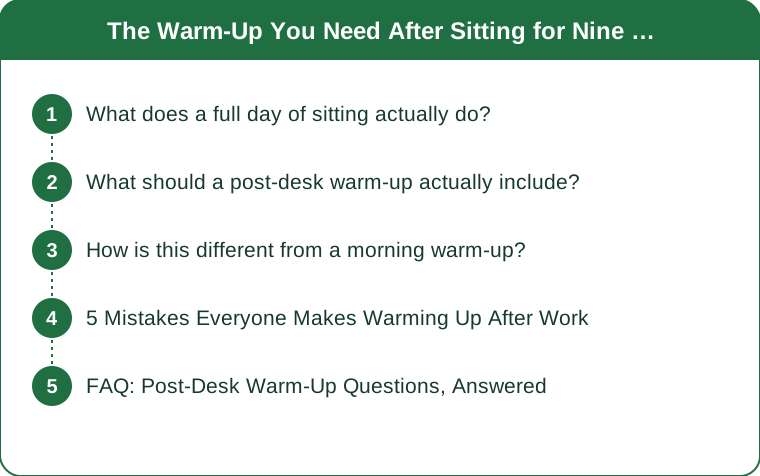
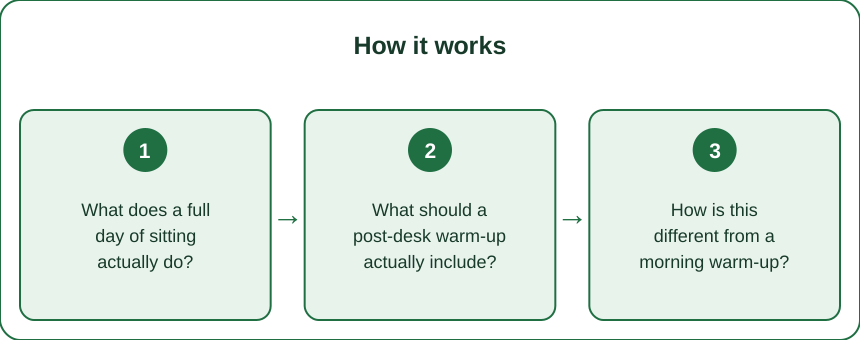
What does a full day of sitting actually do?
Three things, and they’re specific enough to target directly.
Hip flexors shorten. Your hip flexors spend the day in a shortened position. They don’t ‘tighten’ in a permanent structural sense over one day, but they become neurally resistant to lengthening, which limits hip extension - the movement that powers squats, lunges, running, and almost everything else.
Glutes go quiet. This is often called gluteal amnesia, and while the name is dramatic, the effect is real: prolonged compression and inactivity reduces how readily your glutes fire. Your body compensates by recruiting hamstrings and lower back, which is why a post-work squat session can leave your low back sore rather than your legs.
Thoracic spine stiffens. The mid-back locks into slight flexion from screen posture. That limits overhead reach and shoulder rotation, which affects presses, pull-ups, and any overhead work more than people expect.
What should a post-desk warm-up actually include?
Eight to ten minutes, in this order.
1. Hip flexor lengthening - 90 seconds per side. Half-kneeling position, back knee down, squeeze the glute on the back leg and gently shift forward. The glute squeeze is the part everyone skips and the part that makes it work.
2. Glute activation - 2 minutes. Glute bridges, 15 reps, then a 20-second hold at the top. Follow with 10 lateral band walks each direction if you have a band. You want to feel the glutes burning before you touch a barbell.
3. Thoracic rotation - 90 seconds. Open-book rotations lying on your side, 8 per side, moving slowly and letting your head follow your arm.
4. Dynamic hip and leg work - 2 minutes. Leg swings front-to-back and side-to-side, 10 each, then 10 walking lunges with an overhead reach.
5. Sport-specific ramp - 2-3 minutes. Whatever you’re about to do, done lighter. Lifting? Empty bar sets. Running? Three minutes of easy jogging with strides.
The order matters. Lengthen first, activate second, move third, specific last.

How is this different from a morning warm-up?
A morning warm-up is fighting general stiffness and low body temperature. Your tissues are cool, your nervous system is still coming online, and the answer is broad, gradual, whole-body movement.
A post-desk warm-up is fighting specific positional adaptation. Your body temperature is fine. Your nervous system is awake. What’s off is that certain muscles have been shortened, certain others have been dormant, and your movement patterns have quietly reorganized around that.
Practically: a morning warm-up can be 5 minutes of generic movement and be adequate. An evening post-desk warm-up needs to be more targeted and slightly longer, because you’re undoing something specific rather than just raising temperature.
The common mistake is doing the morning version at 6pm - jumping jacks and arm circles, feeling warm, and going straight into loaded squats with hips that haven’t extended fully since 8am.
5 Mistakes Everyone Makes Warming Up After Work
1. Skipping it because you’re already warm from the commute. Being warm and being mobile are different states. A walk from the parking lot raises your temperature without addressing hip extension at all.
2. Static stretching the hamstrings. Post-desk hamstrings usually feel tight because they’re being over-recruited to compensate for quiet glutes, not because they’re short. Stretching them harder doesn’t fix the compensation - activating the glutes does.
3. Going straight to the exercise you’re worst at. If overhead pressing is your weak point and your thoracic spine is locked from screen posture, that’s the worst possible first movement. Save your most mobility-demanding lift for later in the session.
4. Rushing because you’re already short on time. The 6pm session is the one most likely to be squeezed, so the warm-up is the first thing cut. This is backwards - it’s the session that needs the warm-up most.
5. Treating soreness in the low back as normal. If your low back is the sore part after a leg session, that’s a glute recruitment signal, not a badge. It usually resolves once activation work goes in front of the session.
FAQ: Post-Desk Warm-Up Questions, Answered
How long does this really need to be?
Eight to ten minutes covers it. Below five you’ll skip the activation work, which is the highest-value part. Above fifteen and you’re eating into training time for diminishing returns.
Does walking during the workday replace this?
It helps a lot - regular movement breaks reduce how much positional adaptation accumulates. But even with a walking pad, your hips spend most of the day in a fairly narrow range, so the extension work still earns its place.
Should I do this on rest days too?
A shortened version - hip flexor work and thoracic rotation, five minutes - on non-training days is genuinely useful and takes almost nothing. This is general information, not medical advice; persistent pain rather than stiffness is worth a professional look.
TL;DR:
- Nine hours of sitting shortens hip flexors, quiets glutes, and stiffens the thoracic spine
- A generic morning-style warm-up addresses none of those three
- Order matters: lengthen hips, activate glutes, rotate the upper back, then move, then get specific
- Tight-feeling hamstrings after a desk day usually mean quiet glutes, not short hamstrings
- Low back soreness after leg work is a glute recruitment signal worth fixing at the warm-up
The evening session is the one that gets its warm-up cut, and it’s the one that can least afford it.
Keep Reading
This article is for general informational and styling purposes only. Fit, sizing, and product availability may vary.