The Dryland Warmup Swimmers Skip (And Why It Matters More Than the Pool Warmup)
Quick Answer: A pool warmup (easy laps) raises heart rate and loosens muscles generally, but it doesn’t specifically prepare the shoulder joint’s full range of motion the way dryland work does, so a 5-10 minute dryland routine of arm circles, band pull-aparts, and shoulder rotations before getting in the water meaningfully reduces shoulder strain, especially for swimmers doing significant freestyle or butterfly volume.
Swimmers are famously prone to shoulder issues, and a big part of why is that the in-water warmup doesn’t take the shoulder through its full range of motion the way dryland mobility work does before the repetitive stress of a full workout begins.

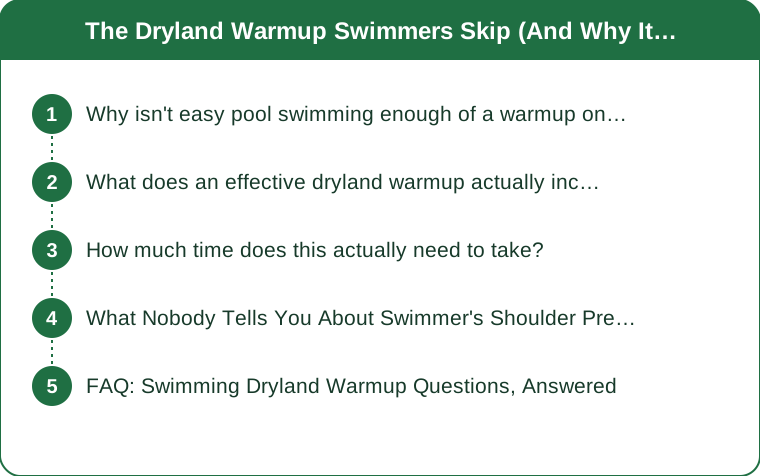
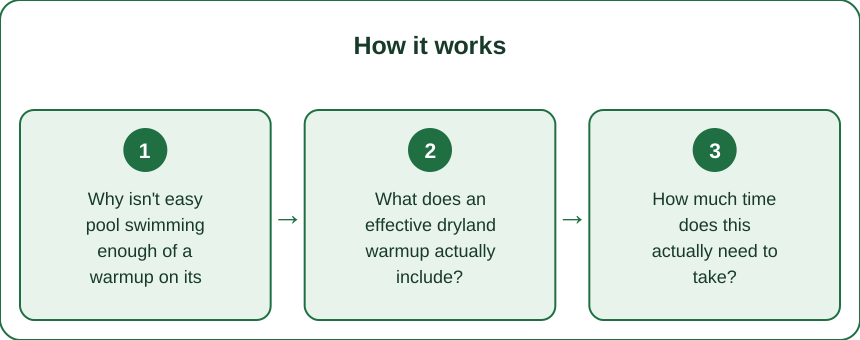
Why isn’t easy pool swimming enough of a warmup on its own?
Easy laps warm up cardiovascular systems and general muscle temperature, but the shoulder’s specific overhead rotational movement pattern in swimming strokes benefits from targeted mobility work first — going straight into stroke work, even at an easy pace, means the shoulder is performing its most demanding range of motion before it’s been specifically prepared for it, which is a big part of why shoulder impingement is so common in swimmers.
What does an effective dryland warmup actually include?
Band pull-aparts and external rotation work (using a light resistance band) activate the rotator cuff muscles that stabilize the shoulder during strokes, while large arm circles progressing from small to full range mobilize the joint capsule itself. A few minutes of each, done before getting in the water, specifically prepares the exact movement pattern swimming demands, rather than the more general prep that easy laps provide.

How much time does this actually need to take?
5-10 minutes is enough for most swimmers — this isn’t meant to replace a broader warmup but to add a targeted layer specifically for shoulder health before the higher-volume, repetitive strokework begins. Competitive swimmers doing significant weekly volume may benefit from a slightly longer, more structured dryland routine, but even a short consistent version beats skipping it entirely.
What Nobody Tells You About Swimmer’s Shoulder Prevention
Most swimmers who develop chronic shoulder pain didn’t get there from one bad session — it’s cumulative micro-stress from thousands of repetitions with a joint that wasn’t specifically prepared, and by the time pain shows up, it often represents months of accumulated strain. Dryland warmup isn’t a dramatic fix that prevents all shoulder issues, but it measurably reduces the cumulative load on an under-prepared joint over a season of swimming.
FAQ: Swimming Dryland Warmup Questions, Answered
Do I need actual equipment for a dryland swim warmup?
A light resistance band is genuinely useful and inexpensive, but bodyweight arm circles and shoulder rotations alone still provide meaningful benefit if you don’t have one.
Should dryland warmup happen right before getting in the pool, or earlier?
Right before, ideally within a few minutes of starting your swim, since the goal is to prime the shoulder joint for the specific work about to happen, not to warm up hours in advance.
Is dryland warmup only necessary for competitive swimmers?
No — recreational swimmers doing regular freestyle or butterfly-heavy sessions benefit just as much proportionally, since shoulder strain scales with repetitive volume, not competition level specifically.
TL;DR:
- Pool warmup laps raise general heart rate but don’t specifically prepare the shoulder’s range of motion
- Band pull-aparts and progressive arm circles target the exact movement pattern swimming demands
- 5-10 minutes before getting in the water is enough for most swimmers to see the benefit
- Shoulder strain in swimmers is cumulative, so consistent dryland prep matters more than any single session The warmup that actually protects a swimmer’s shoulder happens on the pool deck, not in the water — it’s a small addition with an outsized payoff over a season.
Keep Reading
This article is for general informational and styling purposes only. Fit, sizing, and product availability may vary.