Why Static Stretching Before a Workout Might Be Quietly Working Against You
Quick Answer: Research consistently shows that static stretching (holding a stretch for an extended period) immediately before strength or power-based exercise can temporarily reduce muscle power output and performance, while dynamic stretching (moving through a range of motion) better prepares muscles for activity — making dynamic stretching the better pre-workout choice, with static stretching more appropriate for after exercise or as a separate flexibility session.
The instinct to hold a deep stretch before a workout comes from good intentions. The research on timing, though, points toward saving that hold for afterward instead.

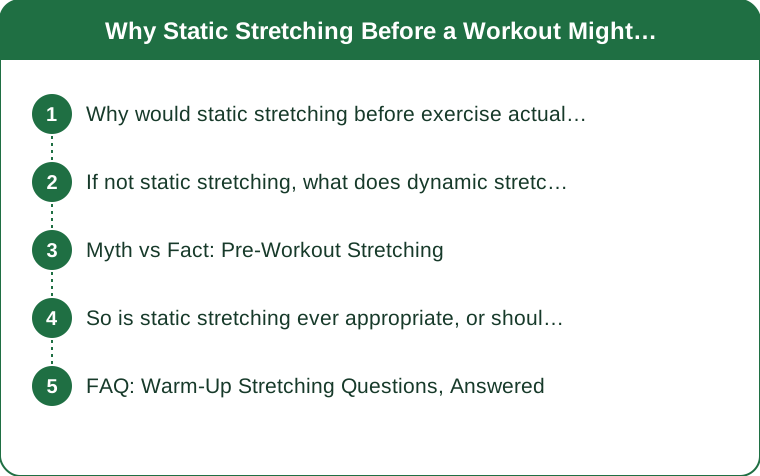
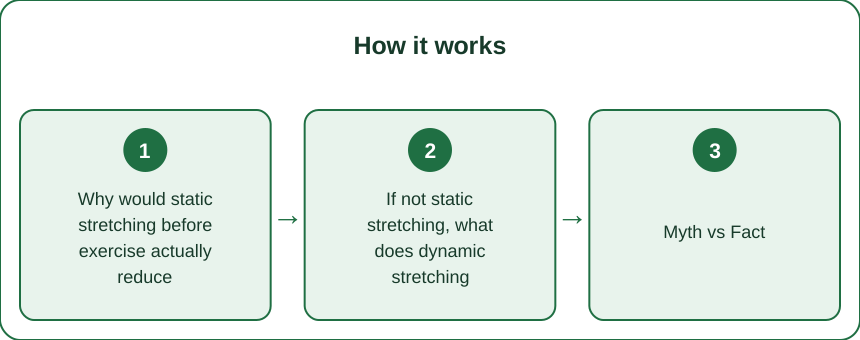
Why would static stretching before exercise actually reduce performance?
Multiple studies have found that prolonged static stretching temporarily decreases muscle strength and power output, an effect sometimes called stretch-induced strength deficit, lasting roughly 30-60 minutes after the stretch. The proposed mechanisms include temporary changes in muscle-tendon stiffness and altered neural activation, both of which can reduce a muscle’s ability to generate maximal force immediately afterward.
This effect appears most significant for activities requiring maximal strength or power output (heavy lifting, sprinting, jumping), and less significant for lower-intensity activity.
If not static stretching, what does dynamic stretching actually do differently?
Dynamic stretching moves joints and muscles through a controlled range of motion (leg swings, walking lunges, arm circles) rather than holding a fixed end-range position. This approach raises muscle temperature and increases blood flow similarly to static stretching, but without the same temporary strength-reducing effect, while also more directly rehearsing movement patterns similar to the upcoming workout.
This is why dynamic stretching has become the standard recommendation in most current sports science and strength coaching guidance for pre-workout preparation.

Myth vs Fact: Pre-Workout Stretching
Myth: Static stretching before exercise prevents injury. Fact: Current research doesn’t strongly support static stretching alone as an effective injury prevention strategy before exercise; a proper warm-up including dynamic movement is more consistently supported.
Myth: Static stretching is bad for you in general. Fact: Static stretching has real value for long-term flexibility gains — the issue is specifically the timing, not the practice itself.
Myth: Skipping stretching entirely and just starting a workout is fine. Fact: Some form of warm-up (dynamic movement, gradually increasing intensity) still meaningfully reduces injury risk and improves early-workout performance compared to no warm-up at all.
So is static stretching ever appropriate, or should it be avoided entirely?
Static stretching remains valuable — just better placed after a workout, or as a separate dedicated flexibility session entirely apart from strength or power training, when the temporary strength-reduction effect isn’t a concern.
For activities that are primarily about flexibility and range of motion rather than power output (like a gentle yoga or mobility-focused session), the timing concern is less relevant since maximal power output isn’t the goal of that particular session anyway.
FAQ: Warm-Up Stretching Questions, Answered
How long should a dynamic warm-up last before a workout?
Most guidance suggests 5-10 minutes of dynamic movement covering the major muscle groups involved in the upcoming workout is sufficient.
Does the static stretching performance effect apply to all types of exercise?
The effect is most documented for maximal strength and power activities; its impact on lower-intensity or purely aerobic exercise appears smaller.
Is it fine to do a light static stretch if it just feels good before a workout?
Brief, light static stretching (not prolonged, deep holds) is less likely to produce a meaningful performance effect, though dynamic movement remains the more evidence-supported primary warm-up choice.
TL;DR:
- Prolonged static stretching before exercise can temporarily reduce muscle power output for 30-60 minutes
- Dynamic stretching raises temperature and blood flow without the same performance cost
- Static stretching remains valuable — just better timed after a workout or in a separate session
- Current sports science guidance favors dynamic movement as the primary pre-workout warm-up
Saving the long static holds for after your workout, and leading with dynamic movement instead, is a small timing shift that current research consistently supports.
Keep Reading
This article is for general informational and styling purposes only. Fit, sizing, and product availability may vary.