Do You Actually Need to Warm Up Before a Walk?
Quick Answer: For a gentle stroll, no - the first five minutes are the warm-up. For a brisk walk, a hill walk, a cold morning, or a walk with a weighted pack, yes - a short 3 to 5 minute warm-up genuinely reduces stiffness and early-walk niggles. The rule that covers every case: start at an easy pace for 5 minutes before going brisk, and add ankle circles, leg swings, and calf raises when it is cold, hilly, or loaded. What you should not do is static stretching beforehand.
Here is when it matters, when it does not, and exactly what to do.

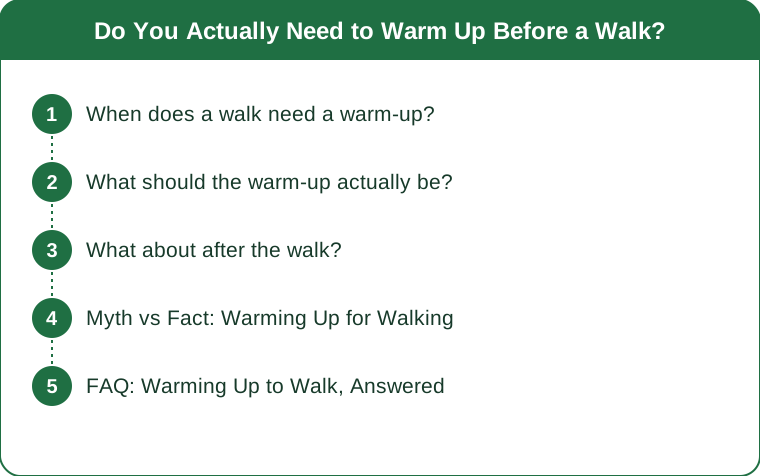
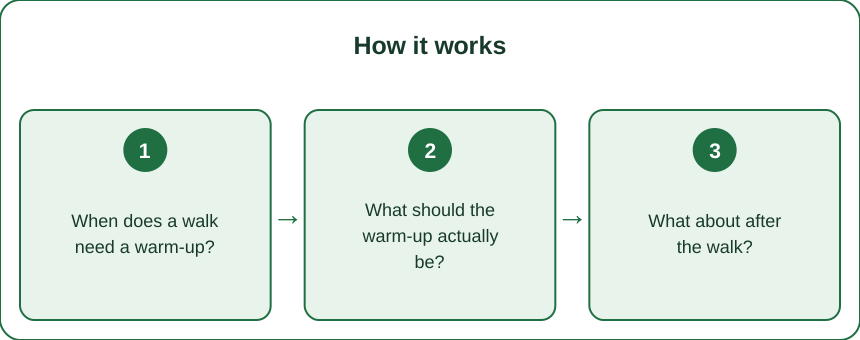
When does a walk need a warm-up?
A gentle stroll does not need one. The intensity is low enough that the first five minutes are themselves the warm-up, and adding anything is unnecessary.
A brisk walk does, particularly from a standing start. Going from sitting at a desk straight into a 6 km/h pace asks a lot of cold calves and Achilles tendons, and that is where early-walk niggles come from.
Cold weather makes it matter more. In cold air, muscle and tendon tissue is less compliant, which is precisely why the same walk feels stiff in October and fine in July.
Hills change it substantially. Starting a walk on an uphill loads the calves and Achilles immediately with no gradual build, which is the most common route to a sore start.
Load changes it too. A weighted vest or a loaded pack raises the demand meaningfully, and the same walk becomes a different activity.
Age and history matter honestly. Previous Achilles or calf problems, or simply being older, mean tissue takes longer to become compliant - and the people who benefit most from five minutes are the ones who most often skip it.
What should the warm-up actually be?
Start with 5 minutes of easy walking, always. This is the entire warm-up for most walks, and it is more effective than any set of exercises done standing still.
Add ankle circles, 10 each direction per foot. The ankle is the joint doing the most work in walking, and it is the one most often stiff first thing in the morning.
Do 10 leg swings per leg, forwards and back. Dynamic movement through range prepares the hip flexors and hamstrings without the drawbacks of holding a stretch cold.
Add 15 calf raises before a hill walk. They prime exactly the tissue that takes the load on an uphill start, and they take thirty seconds.
Include 10 walking lunges if you are carrying weight. They prepare the hips and knees for the added load in a way that walking alone does not.
Do not static stretch first. Holding a stretch for 30 seconds on cold muscle temporarily reduces power output and does not prevent injury. Save static stretching for afterwards.
And build pace gradually rather than in a step. Going from easy to brisk over two or three minutes is smoother and more effective than flipping between two speeds.

What about after the walk?
Cool down by slowing for the last 5 minutes rather than stopping abruptly. It eases the transition and helps circulation settle, particularly after a brisk or hilly walk.
Static stretching belongs here. Calves, hamstrings, and hip flexors, 30 seconds each, when the tissue is warm and compliant.
Prioritise calves after a hill walk. Both gastrocnemius (straight knee) and soleus (bent knee) need attention, and most people only ever stretch the first.
Add a hip flexor stretch if you sat all day before walking. The walk itself does relatively little to lengthen them, so the post-walk window is the useful one.
Do not skip the cool-down in cold weather. Standing still in the cold immediately after stiffens things quickly, and walking the last five minutes gently is a better transition.
Rehydrate even when it is cold. Cold weather blunts thirst, so people routinely finish autumn walks mildly dehydrated without noticing.
And note any recurring niggle. A calf that complains in the first ten minutes every time is telling you something specific - usually that the start is too abrupt or the footwear is worn. Persistent pain deserves proper assessment - this is general information, not medical advice.
Myth vs Fact: Warming Up for Walking
Myth: Walking is too gentle to need any preparation. Fact: A gentle stroll genuinely does not. A brisk walk from a cold start on a hill in October is a different activity with different demands.
Myth: You should stretch before exercise. Fact: Static stretching cold reduces power output temporarily and does not prevent injury. Dynamic movement before, static stretching after.
Myth: A warm-up needs to take fifteen minutes. Fact: Three to five minutes covers it for walking. Five minutes of easy walking is the majority of the benefit.
Myth: If nothing hurts, you do not need one. Fact: The point is avoiding the accumulation of small irritations, most of which build gradually rather than announcing themselves.
Myth: Warming up is only for older or injured people. Fact: They benefit most, but the cold-start calf niggle happens at any age. It is a temperature and tissue issue, not an age one.
Myth: The treadmill warm-up counts for an outdoor walk. Fact: Broadly yes, provided you actually start easy. The mistake is starting at target pace, indoors or out.
FAQ: Warming Up to Walk, Answered
Do I need to warm up for a normal walk?
For a gentle stroll, no - the first five minutes are the warm-up. For a brisk walk, hills, cold weather, or added load, a short warm-up genuinely helps.
How long should it take?
Three to five minutes. Five minutes of easy walking before you go brisk is most of the benefit on its own.
What exercises are worth doing?
Ankle circles (10 each direction), leg swings (10 per leg), and calf raises (15) before a hill. Add walking lunges if you are carrying weight.
Should I stretch before walking?
No. Static stretching on cold muscle temporarily reduces power and does not prevent injury. Do it afterwards, when tissue is warm.
Why do my calves hurt at the start of walks in autumn?
Cold tissue is less compliant, so an abrupt start loads calves and Achilles before they are ready. Five easy minutes usually resolves it.
What about after the walk?
Slow down for the last five minutes rather than stopping abruptly, then stretch calves, hamstrings, and hip flexors for 30 seconds each.
Does a weighted vest change things?
Yes - it makes the walk a meaningfully different activity. Add calf raises and walking lunges before starting. Persistent pain deserves proper assessment - this is general information, not medical advice.
TL;DR:
- Gentle stroll: no warm-up needed. The first five minutes are it.
- Brisk, hilly, cold, or loaded walks: yes - 3 to 5 minutes genuinely helps.
- Always start with 5 minutes of easy walking and build pace over two or three minutes rather than in a step.
- Add ankle circles (10 each way), leg swings (10 per leg), calf raises (15) before hills, walking lunges if loaded.
- No static stretching beforehand - it temporarily reduces power and prevents nothing.
- Cool down by slowing for 5 minutes, then stretch calves (straight and bent knee), hamstrings, and hip flexors.
- Drink afterwards even when cold - cold weather blunts thirst.
A calf that complains in the first ten minutes every time is telling you the start is too abrupt. Persistent pain deserves proper assessment.
Keep Reading
This article is for general informational and styling purposes only. Fit, sizing, and product availability may vary.